
Golf Layup Strategy: When Smart Players Don't Go for the Green
The short answer
Lay up when the cost of missing is bigger than what you gain by getting there, and when you can leave yourself a shot you like. If a miss brings water, out of bounds or a buried lie into play, and the shot only comes off on your best swing, laying up to your favorite wedge distance is almost always the better play.
Make these decisions with a Tour caddie, on every shot: the target, the club and where you can afford to miss.
Free for 7 days on the App Store · iPhone and Apple Watch
There is a stubborn idea in amateur golf that laying up is giving up. Tour caddies see it the other way round: deciding when to lay up, and exactly where, is one of the most useful decisions in course management, and getting it right saves more shots than any perfect swing.
It is also one of the decisions GoCaddie helps with most: your caddie gives you the play before you pull a club.
What is a layup in golf?
A layup is a deliberate decision to play short of a target, usually short of the green or short of a hazard, so your next shot is easier.
The important word is deliberate. You are choosing a predictable result over a long shot that only sometimes comes off, even when the long shot looks tempting.
How caddies weigh going for it
Picture a par 5. You are 235 yards out, water guards the front right of the green, and you can only get there with a perfectly struck fairway wood.
A caddie asks two questions: what happens if this comes off, and what happens if it does not?
If it comes off, you have an eagle putt or an easy chip for birdie. If it does not, and for most golfers that is more often than not, you are in the water: a penalty stroke, a drop and a pitch over the same water.
Bogey is likely and double bogey is in play. Lay up instead to a full wedge distance, and your third shot is one you hit every week. Par is very likely and birdie is a real chance.
Over a round, choosing the option with the better average result, rather than the most exciting best case, keeps big numbers off the card. That is the heart of layup strategy.
Hazards change the math
The same shot can be smart on one hole and reckless on the next. A shot you pull off half the time makes sense when the miss is light rough beside the green: you still have a simple chip.
The very same shot makes no sense when the miss is water, because failure now costs a penalty stroke and another shot over the hazard.
So before you decide, look at where the miss goes, not just where the green is. Water, out of bounds and deep bunkers on the aggressive line are the biggest reasons to lay up on par 5s and long par 4s.
When to lay up
Whatever your level, these situations nearly always favor the layup:
- You cannot carry the hazard with a comfortable swing. If you have to strike it perfectly to clear the water, the risk is too high. Take the club that gets you there easily, or lay up.
- The green is almost reachable, but not quite. Half committed attempts at a green just beyond your range usually finish in rough, trees or the hazard short of the green.
- The layup leaves your favorite shot. If you are strong from 80 yards and shaky from 120, lay up to 80.
- The wind is in your face and you are already at the edge of your range. Shots into the wind fly shorter and higher, so a carry you can make in calm air may be out of reach today.
When to go for it
Laying up is not always the answer. Sometimes going for the green is clearly the better play.
The miss is safe
If the area around the green is rough or a shallow bunker with no penalty areas, and you can still make par from there, the chance of being on the green in two is worth taking.
Think about the next shot, though. If the likely miss leaves a hard chip from thick rough to a short sided pin, a layup to the fairway can still be the better option, even from further back.
You need a birdie
The situation matters. In a match where par will not win the hole, or on the last holes of a competition when you need to make up ground, accepting more risk for a higher ceiling makes sense.
In a normal medal round, the play that gives the best average score is usually right.
You are hitting it well
How you are playing that day is a real factor. If you have been striking the ball cleanly and the shot suits your shape, the attempt becomes more reasonable, as long as the miss is still acceptable.
Base that confidence on what you have actually hit today, not on a feeling.
How to pick the perfect layup target
Deciding to lay up is only half the decision. A careless layup can leave an awkward number, a bad lie or a poor angle. Here is how to choose the spot:
- Know your best approach distance. Find the yardage from which you hit the most greens, often a full wedge. That is your target number.
- Think about the angle. If the pin is front left, laying up to the right side of the fairway often gives a better line in than laying up straight.
- Avoid in between distances. A yardage that falls between your full wedge and your next club forces a partial swing. Leave yourself a full shot instead.
- Use a club you trust. Lay up with a club you hit straight, not the longest one in the bag.
Why a full swing beats a half swing
Many golfers lay up as far forward as they can, leaving forty or fifty yards. For most players that is a harder shot than a full wedge from further back.
A full swing is the one you repeat most, so it is the one you control best.
Work out the gap between your wedges. If your sand wedge goes 90 yards and your pitching wedge 115, a layup that leaves 100 yards puts you in no man's land.
Aim to leave 90 or 115 instead, and you will play your third shot with a committed, full swing.
Make the layup decision with a Tour caddie
The layup is a perfect example of where a caddie makes an immediate difference.
The carry to the hazard, the right spot to leave the ball for your game, the angle that opens up the pin: a Tour caddie weighs these in seconds and gives you one clear play.
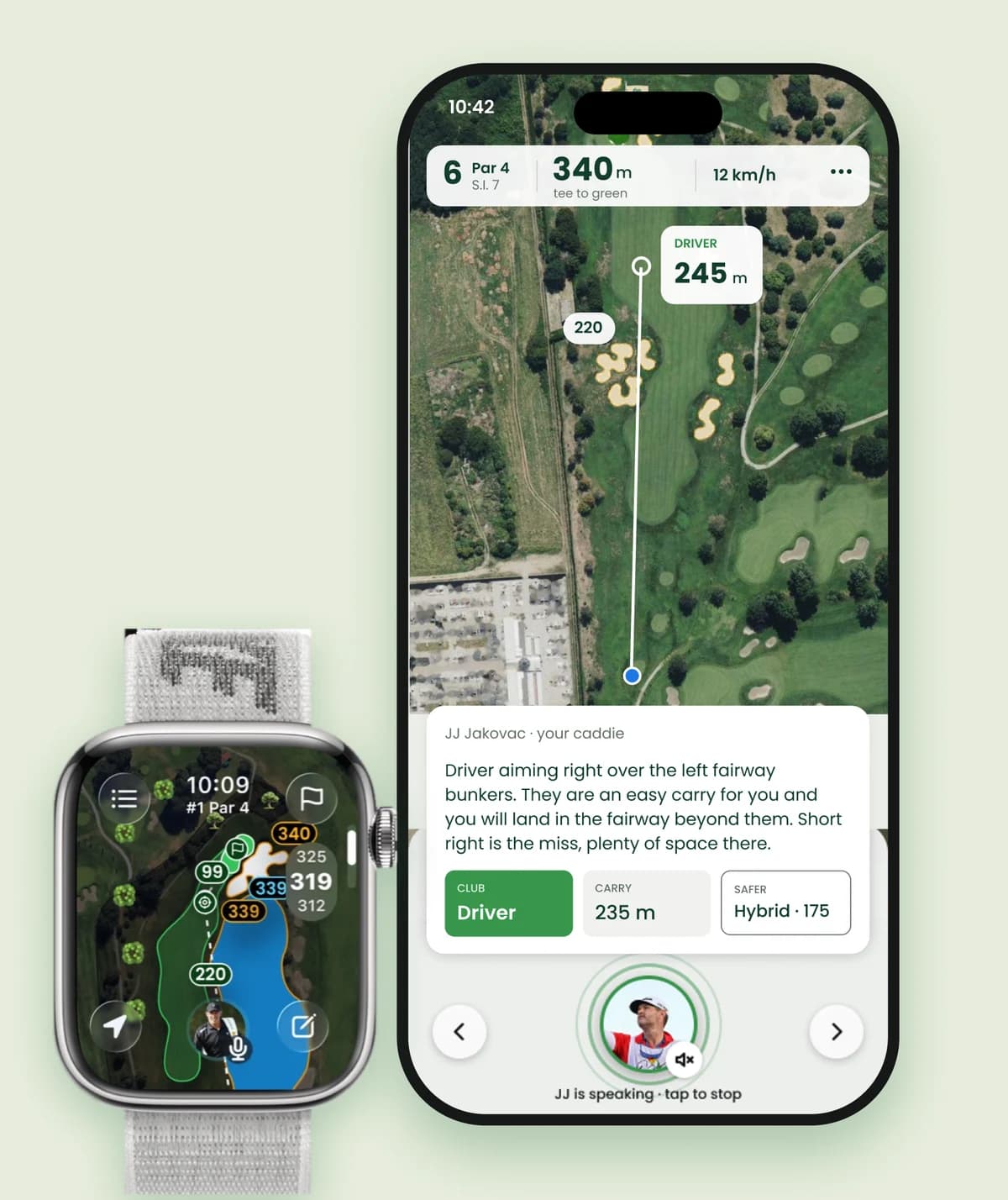
That is what GoCaddie does on your second shot into a par 5. Your caddie reads the distance, what's in play, the conditions, your clubs and your game, and tells you the play: the club, where to aim with a target you can see, and where you can afford to miss.
If you would rather go for it, say so, and your caddie talks it through with you. Then you commit.
Questions golfers ask
Do professional golfers lay up on par 5s?
Yes, often. Tour players can reach most par 5s in two, but they still lay up when water or a tucked pin makes the miss too expensive, or when a wedge from a good number gives them a better chance at birdie than a long shot into trouble.
What is the best distance to lay up to?
Your favorite full swing distance, usually a full wedge. A full swing with a club you trust is easier to control than a half swing, so leave yourself a number you like rather than getting as close to the green as possible.
Is laying up the same as playing scared?
No. A good layup is a deliberate choice of where to play your next shot from. Going for a green you can only reach with a perfect strike, with trouble waiting if you miss, is usually the more costly choice.


The right play, on every shot.
Twelve Tour caddies. Pick one, and get the play in your ear before every shot.
Try your Tour caddie free on the App StoreOn the App Store · 7 days free · Cancel anytime