
Golf Course Management: The Complete Strategy Guide

The short answer
Golf course management is the skill of choosing the right target, the right club and the right amount of risk for every shot you play. It is not about hitting better shots. It is about making better decisions with the shots you already have, and it is the quickest way for most golfers to stop wasting strokes.
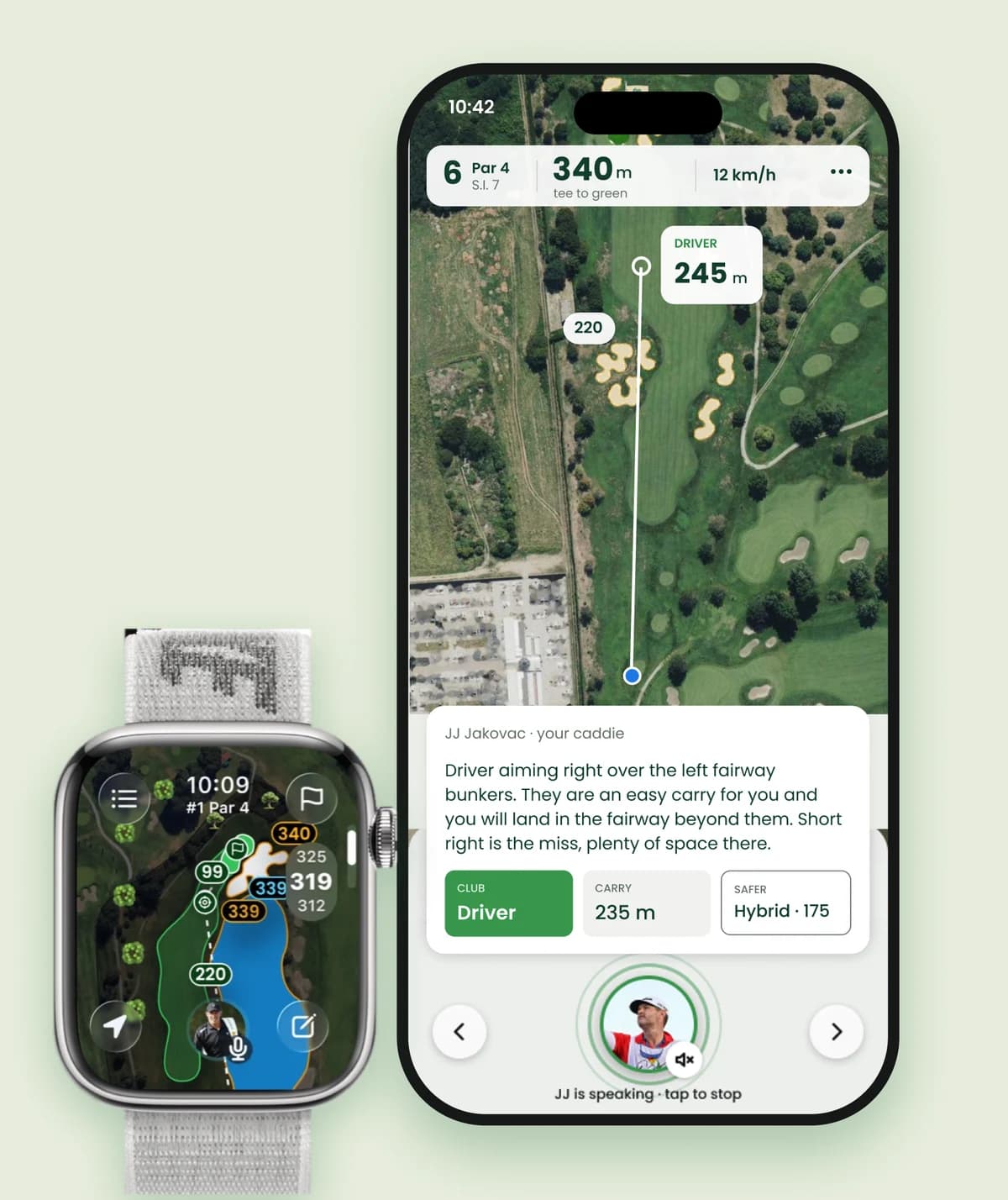
Make these decisions with a Tour caddie, on every shot: the target, the club and where you can afford to miss.
Free for 7 days on the App Store · iPhone and Apple Watch
The best golfer in your group does not always hit the best shots.
Very often they simply make fewer expensive decisions: no hero shot from the trees, no carry over water they only clear on their best day, no flag hunting when the pin sits behind a bunker.
Tour caddies spend their careers on exactly these choices, and GoCaddie puts one of them in your ear to give you the play on every shot. This guide explains how they think, so you can use the same principles in your next round.
“Most amateurs normally just see the flag and hit at the flag. What we’re going to do is… plan for the miss. If we pull it, it goes next to the flag. If we hit our great shot, it goes right in the middle of the green and we still have a look at birdie.”
Why course management matters more than you think
Look back at your last round and count the strokes that came from a bad decision rather than a bad swing. A penalty after taking on water you had no reason to take on.
A double bogey that started with driver on a hole that did not need it. A chip from the wrong side of the green because you aimed at a flag tucked over a bunker. Most golfers find several. Those are the strokes course management saves.
The golfer who avoids penalties, turns down low percentage shots and plays to their strengths will usually beat a golfer with a better swing who makes poor choices. And unlike a swing change, a better decision works on the very next shot.
What golf course management actually means
Course management is a way of deciding, shot by shot, which option gives you the best chance of the lowest score on that hole. It comes down to four things:
- Weighing the risk and the reward of each option in front of you.
- Knowing honestly what you can do with each club, on a normal swing.
- Reading the conditions: wind, slope, how firm the ground is and where the pin sits.
- Committing fully to the plan once you have chosen it.
It does not mean playing safe on every hole, and it does not mean attacking every flag. It means having a clear reason for the shot you choose, every time.
The five principles of course management
1. Play to your strengths, not to the hole
Most golfers aim where the perfect shot would go. Good players aim where their normal shot ends up.
If your ball curves left to right, plan for it: aim down the left side off the tee so your usual shape keeps the ball in play, rather than aiming at the middle and hoping it flies straight today.
The same goes for the clubs you trust. If you are confident with a hybrid and nervous with a long iron, build your plan around the hybrid. A caddie always works with the player in front of them, not the one in the textbook.
2. Know the cost of every miss
Before every shot, decide which side is the safe miss and which side is expensive. With water left and light rough right, a miss right is almost always better, even if it leaves a slightly harder next shot.
A miss into rough costs you half a shot at most. A miss into water costs you at least one, plus the next shot.
Many golfers think about the best result. Good decision makers think about the worst likely result and choose a shot that protects against it. That is how big numbers disappear from a scorecard.
3. Aim at the fat part of the green
The flag is not always your target. When the pin is tucked behind a bunker or close to an edge, aiming straight at it means an ordinary miss leaves you short sided, in sand or off the green with little room to stop the ball.
Aim at the widest part of the green instead. A two putt par from thirty feet beats a chip from a bunker every time.
Attack the flag only when the upside clearly outweighs the downside: the pin is accessible, the shot is one you hit well, and your likely miss still leaves an easy next shot.
4. Play the par 3s and par 5s differently
Par 3s are where many golfers lose shots to water, bunkers and out of bounds, because there is no second shot to recover with.
Take enough club to carry any trouble in front of the green comfortably, not just on your best strike, and stay away from flags tucked beside trouble.
On par 5s, ask a simple question first: can I reach the green in two with a comfortable margin? If the honest answer is no, choose a layup spot that leaves your favorite full wedge distance, on the side of the fairway that gives the best angle to the pin.
A planned third shot from a number you like is a far better scoring chance than a long second that runs out of steam in a hazard.
5. Manage the whole round, not just the shot
A round is a long run of decisions, and the worst ones usually follow a bad hole. After a bogey or a double, the urge to win the shot back pushes golfers toward risks they would never take with a clear head.
The better response is to play the next hole exactly as you planned it before the round started.
That patience is what stops one bad hole becoming three. Plan your round before you tee off, decide which holes you can attack and which you just need to get through, and stick to the plan unless something real changes, like the wind.
A simple routine: four questions before every shot
You do not need a yardage book to manage your game well. Before each shot, ask yourself four questions:
- What is my target, and is it really the right target for this situation?
- Where does a bad miss end up on each side, and what would it cost me?
- Is this the right club for the conditions right now, not for a perfect day?
- Am I fully committed to this shot, or am I still deciding?
Once it becomes a habit, this takes about ten seconds. If you cannot answer the last question with a clear yes, step back and settle it before you swing.
A committed swing at a sensible target almost always beats a hesitant swing at an ambitious one.
Course management off the tee
Driver is not always the right club. On tight holes, or holes where the angle into the green matters more than length, a fairway wood or hybrid that finds the fairway can leave an easier second shot than a driver in the trees.
The extra distance rarely makes up for a lost ball or a blocked approach.
Pick your tee shot by working backward from the green. Where do you want to play your approach from? Which side of the fairway opens up the pin? Then choose the club that gets you there most often.
Course management around the green
Short game decisions save as many shots as long game ones. When you are chipping, aim for the part of the green that gives you the most room, not straight at a hole cut close to the edge.
Look at the slope before you choose the shot. If you are not confident with a high, soft pitch, a simple low running chip that you hit well is usually the better play.
Get the play from a Tour caddie
Knowing these principles is one thing. Using them on every shot, especially after a bad hole or when a tempting flag is in reach, is the hard part. That is the moment a caddie earns their place.
With GoCaddie, your caddie reads the situation: the distance, what's in play, the conditions, your clubs and your game.
Then you get the play for that moment: the club, where to aim with a target you can see, and where you can afford to miss. Have a different shot in mind?
Say so, and your caddie talks it through with you. Just talk, or double tap for instant advice, and your caddie answers by voice. It works fully on iPhone, and with Apple Watch your caddie and the course map are on your wrist.
Questions golfers ask
Can course management lower my scores without swing changes?
Yes. Course management changes the shots you choose, not the way you swing. Taking water out of play, aiming at the fat part of the green and turning down shots you rarely pull off all save strokes with the swing you already have.
How do Tour caddies decide when to attack a pin?
They look at the lie, the distance, the wind, where the ball will land and what the round needs. For most golfers a simple rule works: attack the pin only when your likely miss still leaves you a fair chance at par, and never when it brings a penalty into play.
What is the difference between course management and golf strategy?
Strategy is the overall plan for the round, for example keeping the driver in the bag on the tight holes or playing the par 5s in three. Course management is the decision you make on each shot to carry that plan out.
How do I practice course management on the range?
Instead of hitting the same club over and over, play imaginary holes from a course you know. Pick a target, name the trouble, check the wind, choose the club and hit one ball. Then ask whether the decision was sound and whether you committed to it.


The right play, on every shot.
Twelve Tour caddies. Pick one, and get the play in your ear before every shot.
Try your Tour caddie free on the App StoreOn the App Store · 7 days free · Cancel anytime